06.29.26
Posted in Amazon, AST SpaceMobile, D2D, Iridium, Regulatory, Spectrum, ViaSat at 7:10 am by timfarrar
Today’s announcement that RocketLab is acquiring Iridium represents a bolt from the blue, not because Iridium is being sold (which had been the subject of speculation for several months), but because RocketLab was the winning bidder. Previous speculation had focused on AST (which RocketLab outbid, much to Iridium’s relief), Viasat and even Amazon (though the value of putting together Globalstar and Iridium’s spectrum was always questionable because it would require completely redesigning Iridium’s existing terminals and satellites).
RocketLab was expected to be an anchor partner in the Equatys joint venture, as I noted back in March, contributing up to $1B of funding in exchange for a contract to build the Equatys satellite buses and launch the satellites. Now RocketLab gets to control its own destiny rather than being under Viasat’s thumb, and instead of competing head-to-head with SpaceX in the D2D market, can focus on what RocketLab and Iridium both perceive to be more promising and protected markets, such as aviation safety and PNT. That’s very clear when the investor presentation emphasizes that Iridium “delivers real time, pole-to-pole global coverage over every ocean, mountain and airway” and builds on Iridium’s recent acquisition of Aireon. Iridium has sold connectivity to the DoD for the last 25 years and is also playing a significant role in support of the Space Force’s PLEO efforts. And if it turns out there is a niche role for a D2D IoT offering, independent of Starlink, then Iridium can support that too.
Now the question is whether Viasat can replace both RocketLab’s bus and launch capabilities, and more importantly its money, to finally get the Equatys venture off the ground. RocketLab’s defection explains why no announcement was made in conjunction with Viasat’s results earlier this month, but this must have been a big shock, given how Space42′s CEO was all but confirming RocketLab’s participation in the joint venture at the Satellite show. It’s hard to imagine that alternative satellite vendors such as MDA would want to simply supply Viasat with buses, or make a substantial financial investment in the venture, or that other startup bus providers would have the money to participate either.
Alternatively, will Viasat have to come to the table with AST and figure out a way to jointly make use of the L-band spectrum? Is that even possible, given that both companies believe their own technical solutions are far superior to the other’s offerings? Does Viasat simply continue what Inmarsat did with LightSquared/Ligado for the last nearly 20 years, and agree to lease more (global) spectrum to AST while taking the view that it will get that spectrum back when AST eventually fails to deliver a viable system? Or will Viasat’s shareholders push for the company to follow Iridium’s path and sell itself to AST? If so they would undoubtedly want many billions of dollars in cash, not just AST shares. It is going to be a long hot summer…
Permalink
06.26.26
Posted in D2D, Financials, SpaceX, Spectrum, T-Mobile at 8:28 am by timfarrar
Since the SpaceX IPO earlier this month, speculation about SpaceX entering the mobile market has reached fever pitch, most recently in an FT article that cites comments made by Gwynne Shotwell to investors during the IPO roadshow. And of course we’ll hear imminently about the results of FCC Auction 113, where SpaceX is one of the bidders, and some analysts have been suggesting that SpaceX will buy much or all of the $3.5B in spectrum that was sold, not just the two unpaired licenses that SpaceX definitely need for their Band 70 offering (and which only sold for $10.5M).
But what is not being talked about is the context of a knife fight behind the scenes between SpaceX and T-Mobile over what T-Mobile will pay for the T-Satellite service after exclusivity expires next month. Because SpaceX was desperate to secure a launch partner and pre-empt Apple’s announcement with Globalstar back in August 2022, the current contract is reportedly only valued at “about $100M” in total since 2022, which means T-Mobile is likely only paying a few million dollars per month for the service. That’s only of order $1-$2 per monthly active user, when less than 10% of T-Mobile customers with T-Satellite included in their plan make use of the service in a given month. Or put another way, about $0.10 per month for each customer with access to the service.
But late last year, when SpaceX looked like it was going to come up short of Elon Musk’s 2025 projection of $15.5B in revenues, it seems the company booked an incremental $632M in (deferred) Starlink Mobile revenues so SpaceX would come close to Musk’s target (SpaceX’s actual reported revenue last year, excluding xAI, was $15.473B). That’s far above the current runrate reported for Starlink Mobile of $85M in 2026Q1.
So now, in order to show growth in 2026, SpaceX needs vastly increased revenues from T-Mobile (5-10 times the current level), when (based on the 2026Q1 runrate) T-Mobile is seemingly paying much less than SpaceX’s other MNO partners. As an example, I understand Rogers in Canada has suggested it might end up paying SpaceX up to CAD100M per year in a market which is about one tenth the size of the US. And we’ve seen numbers being floated like $500M per year for Starlink Mobile to provide service in Iran.
What is clear is that T-Mobile does not believe the service is worth that much, which is why they are being so vocal about how “most of the usage we’re seeing is in national parks” and “we’re seeing a lot less usage than we were originally thinking”, later quantified as “satellite usage is 0.0002% of our total network usage” and “pretty much, no one buys satellite stand-alone”. T-Mobile is even explicitly stating that “we expect that our exclusivity will end”.
T-Mobile is offering some carrots as well as sticks, promoting its new Super Broadband solution with Starlink as a backup for businesses. And of course in Europe, Deutsche Telekom’s support is going to be even more critical after the recent EU 2GHz proposal indicated that Starlink would not be allowed to utilize EchoStar’s spectrum license, even though that license will be extended to spring 2029.
But the proposed D2D joint venture with AT&T and Verizon aims to stop SpaceX from playing off the mobile operators against one another, and the operators have been united in their refusal to consider an MVNO relationship with SpaceX.
This is certainly the right time for the MNOs to hold the line on pricing of the Starlink Mobile service, as it will set an advantageous precedent for future D2D services if the wholesale cost for MNOs is in the low tens of cents per customer per month (an order of magnitude lower than the $2-$3/month assumed by many D2D proponents). And it seems hard to imagine SpaceX turning off the T-Satellite service before its own offering is ready in 2028 (though I wouldn’t completely dismiss the possibility of SpaceX completing the EchoStar transaction early and using some of the Band 70 spectrum on the current Starlink DTC satellites).
Are SpaceX’s current threats enough to change the mobile operators’ minds, even if SpaceX does buy more terrestrial spectrum? It’s always been expected that there will be some direct-to-consumer Starlink Mobile offering, most likely in the form of a smaller version of the Starlink Mini (a Starlink Nano?) operating in MSS frequencies with a much improved battery life, that you can connect to your phone via Bluetooth or WiFi. That’s very different to offering a fully fledged mobile service, when satellite links won’t deliver the data rates and inbuilding penetration expected from a terrestrial network.
But threats to buy a mobile operator or build a terrestrial mobile network seem like a paper tiger, which would do nothing to leverage SpaceX’s “core strengths” as set out in the S-1:
Global leadership in orbital launch services
Unrivaled satellite and connectivity platform across design, manufacturing, deployment, and operations
Truth-seeking AI model enhanced by real-time data
Extreme vertical integration enabling high velocity and superior cost efficiency at scale
Unique ability to scale new trillion-dollar markets across Space, Connectivity, and AI
Business models that are incredibly difficult to replicate
Our mission-driven culture and world-class talent.
So I look forward to seeing the revenues that SpaceX is able to report from Starlink Mobile in Q2 and Q3, and whether this is really a growth engine for the company in 2026, or if revenues actually fall from 2025 levels. If that’s the case then Starlink Mobile will presumably become another business (like Orbital Data Centers) where the hype is focused on what might be achieved with a next generation constellation in 2028 and beyond, while analysts continue seeking attention by playing up the possibility of SpaceX building, buying or leasing capacity for a fully fledged mobile service.
Permalink
06.04.26
Posted in Amazon, Broadband, Financials, SpaceX at 1:10 pm by timfarrar
One of the biggest uncertainties in the SpaceX IPO relates to the potential future growth of Starlink’s consumer business, which we discussed in detail in our 65 page report released on Tuesday this week. The most attention-grabbing claim from ARK Invest is that Starlink represents “a business without precedent” because even the early Starship launches of V3 satellites will produce twice as much revenue each year as it costs to manufacture and launch the satellites and acquire customers to fill them.
Those assertions (endorsed by Elon Musk) have led other analysts to predict that “SpaceX will disrupt [the] $1.6 trillion US communications industry” and justify a downgrade of AT&T, while Goldman Sachs is predicting that Starlink will generate $144B in revenue in 2030.
Starlink undoubtedly has a strong platform for growth, although you have to wonder why SpaceX suddenly decided to raise prices in the wake of a disappointing set of Q1 results, where ARPU dropped sharply, and incremental revenue per new subscriber was unsustainably low. That’s not the action of a company that’s looking to compete aggressively against terrestrial telcos and cable companies where multi-year “price lock” guarantees are all the rage.

Some have tried to explain away the price rises, as being “put in place because Starlink was having trouble coping with recent subscriber demand that was driven by price cuts”. But that doesn’t make much sense when Starlink net adds were lower in 2026Q1 (1.4M) than in 2025Q4 (~1.6M) and overall network performance improved continuously throughout 2025. Even potential terminal manufacturing constraints that were pointed out back in February will have been eased by the combination of fewer subscriber adds and increased production (which went from 170K per week at the end of 2025 to 200K per week as reported in the S-1).
[EDIT] And now Starlink has just announced it reached the 12M customer milestone, 111 days after the 10M milestone in February, which is a slightly slower growth rate than the 52 days from 9M to 10M and the 48 days from 8M to 9M customers.
Returning to the mad claims made by ARK, there are multiple errors in the assumptions, including that Starship will be able to launch 60 satellites right away when the roadshow presentation points out that will only be achieved “over time” and most importantly a dramatic underestimate of terminal costs, which at present are multiples of ARK’s assumed $100.
In their recent investor briefing, ST Microelectronics, who make the key chipsets for Starlink, said that “When you look at Ku band user terminal, I think that actually we’re going to soon reach a plateau” in the cost of their chips (which alone cost “a few tens of dollars” before the rest of the manufacturing takes place). At the end of the day, the cost of Starlink terminals is the key barrier to competing with terrestrial, not the cost of bandwidth.
Most egregious of all are ARK’s estimates of revenue per Tbps. If you look at Starlink’s $11.4B of revenues in 2025 and adjust for product revenues and Starshield/Starlink Mobile revenues that aren’t related to Starlink’s broadband business, then you get broadband service revenue in 2025 of about $15M per Tbps. With each extra Starlink V2 mini satellite adding capacity for ~2000 subs around the world, that’s about $62 of revenue per subscriber per month.
But Starlink’s current bandwidth provisioning will have to at least double if it is to compete fully for terrestrial subscribers. If we take the 10x increase in capacity per satellite on V3, but assume that provisioning doubles, that means each V3 satellite will add enough bandwidth to serve 10,000 new subscribers. At the same $62 per sub per month then that’s only $7.5M per Tbps launched. And if you want to compete with terrestrial then the incremental revenue per sub might only be $40 or so (under $5M per Tbps).
In contrast, ARK assumes that the initial Starship launches will generate $17M per Tbps (with a doubling of total system capacity) and $13M per Tbps if 10 times the current capacity is added, i.e. Starlink adds 6000Tbps, which would equate to winning another 100M subscribers with each generating an average of $65/month. That’s just not remotely credible (and incidentally explains why Musk’s daily or hourly launch tempo for Starship simply can’t be achieved based solely on Starlink demand).
Of course once you fix ARK’s underestimated costs and vastly inflated revenue assumptions then Starlink still looks like a very good business, with potential gross margins of around 60%. And Starlink should be able to capture a meaningful number of customers from terrestrial telcos in developed countries (about 100K per month in the US at the moment) if it does decide to price more aggressively at some point in the future. But don’t take these ridiculous assessments, which are being thrown out there to justify an IPO valuation of $1.75T, as saying anything about the reality of Starlink’s business potential and its impact on terrestrial telcos and cable companies. And ask yourself whether you believe Starlink’s next move will be to increase or decrease the price that customers are paying, especially when the prospect of competition from Amazon just moved even further into the future…
Permalink
06.02.26
Posted in Amazon, Broadband, Financials, Operators, SpaceX at 3:06 pm by timfarrar
I’ve been writing a lot about Starlink’s financials since the SpaceX S-1 came out almost two weeks ago and now I’ve just released my new 65 page report forecasting the opportunity for Starlink’s consumer business. The report pulls together the first detailed breakdown of how Starlink’s customers are distributed around the world, based on weekly monitoring of active terminals, and projects how the reported subscriber base and revenues will grow in the coming quarters and years by country and region.
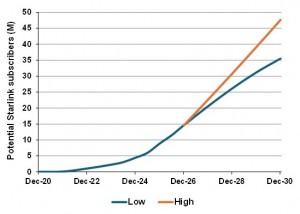
The report analyzes Starlink capacity density and terminal production and how these factors have constrained growth in recent years. It also discusses the limitations to future growth and how successfully Starlink will be able to compete with terrestrial alternatives in different countries. And the report compares the technology of Starlink and Amazon Leo to assess whether there is any realistic prospect of Amazon making significant inroads into Starlink’s subscriber base in the coming years.
Do you know the top 10 Starlink country markets (United States, Brazil, Canada, Argentina, Australia, Mexico, UK, Chile, France, Germany) and how many subscribers are in each country? Do you want to understand how Starlink’s growth in each country has changed since the price cuts in January, and why the price increases last month were so significant for Starlink’s future growth trajectory? You can even see why the various online estimates either significantly overestimate the subscriber base or get the regional distribution dramatically wrong.
This report will be followed up with a detailed set of projections for Starlink’s other business lines later this week, updating our previous company profile, and you can get both reports together at a discount. Or subscribe to the full research service and access our other reports from last year covering the D2D and professional satellite markets that Starlink competes in, plus all of our regular notes on key breaking news in the satellite sector for the next 12 months.
Permalink
03.24.26
Posted in Amazon, AST SpaceMobile, D2D, Globalstar, Lynk, Operators, Services, SpaceX, Spectrum, ViaSat at 5:43 pm by timfarrar
After more than 20 years, it looks like Jay Monroe has finally achieved his goal of selling Globalstar at a profit. In the coming days, I understand that the sale process initiated back in October will reach its conclusion, and Globalstar will be sold at something close to Jay’s asking price of $10B. And as I promised Jay in Paris last September, I’ll owe him an apology for ever doubting that he would be able to make money on his Globalstar investment.
Rumors have been swirling all week here at the satellite conference in Washington DC and many people have guessed that the winning bidder would be Amazon. That seemed to be the most likely outcome back in January. However, I think that Jay took Amazon’s offer to SpaceX and they probably decided to beat it, in order to further cement Starlink’s dominance of the satellite industry. Amazon already faces severe competitive pressure from Starlink in the broadband market, and a Starlink purchase of Globalstar would block another opportunity for Amazon to broaden its appeal and match Starlink’s D2D offer.
Buying yet more spectrum might not be seen as the wisest course of action for SpaceX, if some international regulators decide that because Starlink controls Globalstar’s MSS spectrum there is no need to grant Starlink additional rights in the 2GHz MSS spectrum acquired from EchoStar. But Brendan Carr’s threats that he will block European satellite operators from the US market if the EU withdraws Starlink’s spectrum rights should carry the day in the near term.
In particular, a two year extension is likely to be granted for the current EU 2GHz spectrum licenses (which is conveniently beyond the November 2028 presidential election). And 2029 is a long way away, given the number of balls Elon Musk has to juggle in the next few years to get Starship flying, meet NASA’s moon ambitions and sort out the challenges at xAI and Tesla.
What is much less clear, is what will happen to Globalstar’s C-3 constellation and the relationship with Apple after a sale. Would Apple continue to pay Starlink hundreds of millions of dollars per year to support connectivity on existing iPhones? Would the C-3 constellation still be completed, especially if it takes MDA another two years or more, by which time Starlink might have its own next generation Starlink Mobile constellation on orbit? That decision could go either way, depending on how confident SpaceX is that Starship will be ready to launch the next gen constellation on time.
Meanwhile, in other news, it seems that Viasat has concluded that it will have to put some of its own money on the line to get started with the 2800 satellite Equatys constellation, with RocketLab likely to be chosen as the satellite bus contractor. Plausibly, RocketLab’s recent $1B fundraising could be used to provide an equity injection into the Equatys joint venture.
And AST is telling people that it will now rely on New Glenn for 9 of its first 12 launches, implicitly confirming the rumors that the company can’t figure out how to stack satellites within the much smaller Falcon 9 fairing. Of course, there’s no way that New Glenn will provide AST with anything like 9 launches this year, so AST’s deployment plans will be pushed out even further.
The level of skepticism about AST at the conference is quite remarkable, but despite Starlink’s dominance, there’s little reason for mobile operators to withdraw their support in the immediate future. Instead, with Starlink’s next generation Starlink Mobile constellation at least two years away and alternatives including AST, Equatys and Lynk all on a similar timetable, MNOs can wait and see, and perhaps pray, that one or more alternatives to Starlink ultimately emerges, and that, in the meantime, more clarity emerges about whether their customers actually care about D2D at all.
Permalink
03.06.26
Posted in Aeronautical, Operators, SpaceX at 8:29 am by timfarrar
Last Sunday afternoon (4.11pm Pacific time), March 1, Elon Musk posted a curious tweet:

This came in response to another tweet about use of Starlink on US attack drones, but that’s not the important issue (and in fact, as it applies to US-approved uses, the statement is somewhat misleading: Starlink satellites are widely used in Ukraine for military purposes, with funding from the US Department of War, it’s just that SpaceX uses the Starshield brand for these sales, not the “commercial Starlink” service).
Musk’s tweet states that “weapon systems” using Starlink are “shut down when discovered”. So what did Starlink shut down right after this tweet? That became clear on Monday morning, when general aviation users started complaining that their Starlink service had been affected because “effective immediately, the maximum supported in-motion speed for Roam and Priority plans is 100 mph”. Instead Starlink has introduced Aviation 300 and Aviation 450 plans (with much higher pricing) that allow for usage at up to 300mph and 450mph respectively.
But what is even more notable is that the rules for these new plans require you to submit a scan of your passport, as well as details of the aircraft that the Starlink service will be used on. In contrast, all you need to sign up for the Roam plan is a credit card.
So what “weapon system” flies at not much more than 100mph and shouldn’t be provided to certain passport holders? We all know that Russian attack drones have been an issue in Ukraine and Starlink introduced a whitelisting process last month to address this. But it seems no one thought about Iran at that point in time.
And the remaining question is how did Musk “discover” this on Sunday? God forbid that the Iranian drone which killed six US servicemembers earlier in the day in Kuwait (and was described as “flying slow and low to the ground”) was using Starlink…
Permalink
03.02.26
Posted in Aeronautical, D2D, Globalstar, Operators, Regulatory, Services, SpaceX, Spectrum, T-Mobile at 7:36 am by timfarrar
It was fascinating to see today’s announcement at MWC, that Starlink is partnering with Deutsche Telekom to “support over 140M subscribers across 10 European countries“. Most remarkable is that DT is explicitly confirming that “the service will operate only in Starlink’s MSS (Mobile Satellite Service) spectrum”, effectively treating renewal of EchoStar’s existing 2GHz MSS license in Europe as a fait accompli.
That’s perhaps not surprising, because I’m told that an announcement from the EU on the process for reallocating the 2GHz licenses after they expire in spring 2027 remains stalled, and may take several more months to emerge. As a result, the expectation is that the current licenses (held by Viasat and EchoStar) will be extended, probably by two years, to allow time for that process (with appeals and a need for subsequent actions by national regulators) to conclude.
But there is a wider context here to the alignment between Starlink and Deutsche Telekom here, which is seemingly happening with the implicit backing of the German government (and makes me wonder what will happen to Tesla’s factory in Germany this week).
Back in January, news broke that Starlink had struck a fleetwide deal to equip Lufthansa’s aircraft with connectivity. After the prior loss of IAG to Starlink in November 2025, Lufthansa was the last remaining anchor customer for Viasat’s European Aviation Network (EAN).
Lufthansa’s defection fatally undermined the case to retain EAN in its current form and therefore has called into question the need for Viasat to retain 2x15MHz for its 2GHz MSS license. In supporting Viasat’s application for renewal, Lufthansa had even gone as far as to claim that “The EAN is a critical building block in continuing our journey to offer an industry-leading connectivity solution to our passengers.” Of course, it will take some time to replace the EAN terminals on both Lufthansa and IAG, but that just reinforces the rationale for a two-year extension to the current European 2GHz licenses, before any changes take place.
Those changes could potentially reduce both Viasat and EchoStar to paired 10MHz blocks and free up a third license for a European provider (prompting a fight between the AST/Vodafone partnership and the SES/Lynk/Omnispace grouping). But now I wonder if DT might switch its position and suggest cutting Viasat to 2x10MHz, in order to free up 2x5MHz for IoT, while leaving EchoStar/Starlink with the full 2x15MHz. Though whether that would fly with EU regulators is far from clear.
What is interesting is that Lufthansa’s decision to defect to Starlink was apparently very sudden, in fact I’m told that Lufthansa had been negotiating a major deal with another IFC provider for the last couple of years, which was close to being confirmed publicly, and rumors suggest that the German government had a hand in the switch.
Now we have a similar major deal between Deutsche Telekom and Starlink that comes after DT reportedly vetoed T-Mobile US’s plan to buy EchoStar’s spectrum last summer to enhance the partnership between TMUS and Starlink. And last June, DT had been just as unenthusiastic about any changes to the 2GHz band, stating that “Deutsche Telekom AG plans to continue operating the European Aviation Network (EAN) using the MSS 2GHz spectrum beyond 2027…preserving the current spectrum allocation is crucial for the continued operation and economic viability of the EAN.”
So the natural question is “what changed”? I’m told that even after vetoing the TMUS-EchoStar spectrum deal (and then replacing the TMUS CEO while privately characterizing TMUS as “going rogue”), DT continued investigating D2D options and was one of three companies that looked at Globalstar when that asset was put up for sale last fall (the other two being SpaceX and Apple).
But nothing happened there, and now DT has decided instead to strike a major partnership with Starlink, preferring to rely on the 2GHz MSS band over Globalstar’s Big LEO spectrum. And there’s even a DT panelist (Jaroslav Holis) scheduled to speak at the Equatys event on Wednesday which raises the question of what DT might have been exploring there. So I’m left wondering whether there are wider German political factors behind the decisions of both Lufthansa and Deutsche Telekom to reverse themselves in short order.
Permalink
02.08.26
Posted in Broadband, Financials, Operators, Regulatory, SpaceX at 2:29 pm by timfarrar
On Friday, redacted versions of two SpaceX financial forecasts, one from 2021 and the other from 2023, were disclosed in the Delaware litigation between SpaceX shareholders.
While only very limited numbers in the financial projections remain unredacted (beyond the expectation in the 2021 forecast that “government” revenue for Starlink would grow to $5B by 2027), there is enough that can be extracted to determine that Starlink has exceeded the 2021 revenue forecast, but Starship has fallen dramatically behind expectations even in 2023. The 2021 forecast helpfully used redactions matched to the number of characters, showing that Starlink was first expected to exceed $10B in revenues in 2026, while in actual fact Starlink passed $10B in 2025.
The projected valuations on the last page of this document also make it possible to back into the total company revenues forecast in 2021 and 2027: the $102.8B valuation was 25x revenues, implying a revenue forecast of $4113M for 2021. By 2027 this valuation was expected to have increased 4.9x, to around $500B, which was said to be 20x revenues, implying a revenue forecast of ~$25B for 2027. That again is slightly less than SpaceX’s likely total revenues in 2027, even if you remain skeptical about SpaceX’s ability to meet the current published 2026 forecast of $22B-$24B.
However, the 2023 forecast shows how SpaceX was expecting Starship to start launching Starlink satellites to orbit in 2024, with Falcon 9 phased out for Starlink launches in 2026. Now even on Musk’s optimistic timeline from December 2025, Starlink V3 launches on Starship aren’t expected “at scale” until “around Q4″ of this year. So Starship launches of usable payloads have now consistently remained 12 months out for nearly three years.
It’s also fascinating to me how the ongoing debate about orbital data centers tends to ignore launch constraints. SpaceX is just beginning to scale up to develop these “AI satellites”, but until now the emphasis for Starship has been on getting it ready to launch Starlink V3 in volume. That’s meant building extensive launch pad infrastructure in Florida and seeking permission for a high launch tempo there.
Florida is ideal for Starlink launches to 40 and 50 degree inclinations, which will be much more difficult in Boca Chica. However, Florida is a terrible location for sun synchronous launches, which is where these orbital data centers are supposed to go, to utilize maximum sunlight. Back in 2020, SpaceX conducted the first sun synchronous launch from Florida in more than 50 years, and has continued to launch some Transporter rideshare missions to sun synchronous orbits since then, but this requires a very fuel inefficient “dog leg” maneuver and so is only suitable for light payloads, not bulk launches of AI satellites.
Similarly, undertaking sun synchronous launches from Boca Chica would be extremely challenging (and potentially cause an international dispute), as these rockets would need to fly completely across Mexico, not over the open ocean. That’s why Vandenberg is typically used for sun synchronous missions, but SpaceX hasn’t even begun building a Starship pad there, and a high launch tempo is likely to be very politically controversial in California. So how exactly does SpaceX intend to get these AI satellites to the desired orbit?
Permalink
01.03.26
Posted in Broadband, D2D, Financials, Operators, Services, SpaceX at 11:52 am by timfarrar
The reactions to my comments last month on The Information’s TITV program about SpaceX needing a new story for its planned $1.5T IPO were fascinating, mainly because no one actually disagreed with the fact that SpaceX has consistently missed its targeted revenue growth over the last three years. Back in July 2023 SpaceX originally estimated revenues for the year would double to around $8B, before this whisper number was raised in November 2023 to $9B, with a forecast of $15B in 2024. That caused analysts such as Payload Space to come up with a figure of $8.7B for 2023, which is still often repeated as the actual figure, despite the NY Times finally confirming in August 2025 that SpaceX’s 2023 revenue was only $7.4B (with Starlink generating “roughly $8 billion” in revenue during 2024, implying a companywide total of ~$11B).
In 2025, SpaceX once again appears to have missed the revenue prediction of $15.5B that Musk stated publicly back in June, with Bloomberg reporting in its IPO coverage that “the company is expected to produce around $15 billion in revenue in 2025, increasing to between $22 billion and $24 billion in 2026.” That’s despite surging broadband subscriber numbers, which reached 9.2M by the end of the year as SpaceX dramatically cut the price of its terminals and reduced US residential service pricing to stimulate demand. Of course Starlink’s revenue growth is incredibly impressive, as is the speed with which it has come to dominate the satellite industry, but justifying an $800B current valuation (let alone a $1.5T IPO valuation), usually requires outperforming revenue guidance, not missing it.
Even so, it seems likely that SpaceX’s revenue target for 2026 will once again prove too optimistic, because ARPUs on those millions of customers are much lower than most analysts think (especially now there’s a $5 per month service option for suspended terminals). And the next generation D2D/DTC system won’t start launching in volume until “around Q4″ 2026 (at best since that depends on rapid progress with Starship), while SpaceX can’t access EchoStar’s AWS-4 spectrum until November 2027, so it can’t start offering a Band 70 DTC solution in the US with existing handsets until then.
It’s also undeniable that SpaceX needs more than just Starlink to justify a $1.5T valuation, given that even its expected lead investment bank, Morgan Stanley, only thinks Starlink revenues will get to $126B in 2040. So its understandable that the proposal for space-based data centers took center stage in last month’s reports of IPO preparations.
Curiously, however, data centers didn’t even rate a mention in Starlink’s end of year progress report, which focused instead on talking up the Starlink V3 satellites and the DTC constellation in particular as the key payload for Starship. And interestingly, in this progress report Starlink also modified the company’s September 2025 comments that “in most environments, [DTC] will enable full 5G cellular connectivity with a comparable experience to current terrestrial LTE service,” to instead promise that “in most environments [DTC] will enable full 5G cellular connectivity with a comparable experience to current terrestrial service.”
In many ways, Musk’s plan for space-based data centers offers a Rorschach test for potential SpaceX investors, just like Optimus does for Tesla investors. Both allow for near term demonstrations that look impressive but aren’t meaningfully revenue-generating, while allowing Musk to make long term projections of “infinite” revenues that can be (nearly) infinitely postponed.
In the case of Optimus, he’s claimed “humanoid robots will be the biggest product ever. Because everyone is gonna want one, or more than one,” while for space-based data centers, he’s claimed that “satellites with localized AI compute, where just the results are beamed back from low-latency, sun-synchronous orbit, will be the lowest cost way to generate AI bitstreams in <3 years. And by far the fastest way to scale within 4 years, because easy sources of electrical power are already hard to find on Earth."
Or put another way “Optimus and space data centers are two sides of the same coin…Optimus promises to provide all needed physical labor (and even better than a human!), while space data centers promise to provide all needed mental labor (and even better than a human!).”
But if you read yesterday’s WSJ piece on Optimus and think that Musk is simply lying again because “in public appearances, the robot is often remotely operated by human engineers” then you’ll believe the same is likely true of his plans for SpaceX’s space-based data centers. Conversely if you read that article and think that Tesla is making continued progress in opening up an untapped market opportunity where Adam Jonas “predicts that by 2050, humanoids will bring in $7.5 trillion in annual revenue across the industry globally,” you’ll probably have the same reaction about space-based data centers. And of course the latter are the investors that SpaceX actually wants for any IPO.
This is not to say that the market for either is non-existent: just like many companies are working on robots (with or without legs!), there is plenty of interest in space-based data centers. Both will also be particularly useful to the DoD, and especially in the space market the US government is seen as the best source of new revenue by many players right now.
And SpaceX has substantial advantages both in access to cheap launch, and in the ability to build a distributed network of data centers based on the Starlink V3 bus (which is a much better solution than a handful of extremely large space-based data centers several km in diameter, not least because achieving low latency requires the data center to be in view). However, that’s very different to saying revenue will be “infinite” or that this market can justify a $1.5T valuation for SpaceX.
But to return to my original interview, its particularly amusing to note the CEO of Starcloud suggesting in a subsequent TITV interview that this was “the dumbest thing I’d heard in a quite a long time”, because the dumbest thing I’ve heard in quite a long time is Starcloud’s business plan, which (if you take their story about launching huge arrays into space at face value) is essentially totally dependent on gaining access to Starship launches at cost.
Of course that means sucking up to Elon Musk is a necessity, but when one of SpaceX’s key competitive advantages for Starlink (and a key source of value in any IPO) lies in exploiting the huge difference between the cost and price of Falcon 9 launches, there’s no reason to believe that the same wouldn’t be true for Starship. In other words, SpaceX will be able to launch its own space-based data centers at a much lower cost, compared to the price of Starship launches for third parties, allowing SpaceX to gain far more scale than any other player at much lower cost, just as it has done with Starlink. In fact, I understand that all Starcloud has is some interesting in-space cooling technology, which only becomes valuable in extremely large arrays, and that’s unlikely to be useful if SpaceX’s distributed space-based data center architecture proves more cost effective.
Permalink
09.08.25
Posted in AST SpaceMobile, Echostar, Globalstar, LightSquared, Operators, Regulatory, SpaceX, Spectrum, T-Mobile, Thuraya, Verizon, ViaSat at 5:47 am by timfarrar
My post last week on the potential scenarios for EchoStar assumed that the buyer of EchoStar’s spectrum would be a terrestrial player, because only using the spectrum terrestrially could produce a return that justified paying Charlie Ergen’s asking price. 12 months ago that was true when the rumors were that SpaceX was only willing to pay a few billion dollars for access to EchoStar’s AWS-4 spectrum.
With Deutsche Telekom apparently getting cold feet about buying spectrum for D2D, and Verizon not yet at the table, that meant the most likely scenario was for EchoStar to continue moving forward with its own constellation, in order to keep control of the whole AWS-4 block and significantly constrain Starlink’s D2D capacity in the US (while having the opportunity to monetize the spectrum in urban areas through leases to a wireless operator like Verizon).
But ROI has never been the primary determinant of SpaceX’s decisions, when the opportunity presents itself to dominate an industry and force competitors out. That’s why we are seeing aggressive actions from Starlink in the satellite broadband market, lowering prices for hardware and service in both the consumer and professional markets to make Amazon Kuiper’s entry harder (including a new unlimited maritime plan for merchant vessels at only $2500 per month, which will also undermine Viasat’s NexusWave).
And in this case, by spending $17B, SpaceX has not only persuaded EchoStar to give up its D2D plans but has now made it much harder for any competitor to move forward when they can’t possibly compete with SpaceX’s speed in bringing new satellites to market. That was evident in the article published by The Information in May, where Apple staff working on the D2D project with Globalstar expressed concerns that their bosses would cancel the effort and decide to partner with SpaceX instead. And we’ve seen more on that front in recent months, as Globalstar’s new satellites have been delayed, and Apple was apparently forced to support Starlink on the iPhone 13 in order to secure a new launch slot.
It shouldn’t be ignored that just like in fall 2022, the SpaceX announcement comes right before Apple’s own event tomorrow to announce its new iPhone. So while this might not be on the agenda tomorrow, decisions about the future of the Apple-Globalstar partnership and the new C-3 constellation will be on everyone’s minds. The cancellation of the EchoStar D2D constellation was already a major blow for MDA, but any decision by Apple to pull back from the C-3 constellation would be even more devastating.
SpaceX especially wants Apple to cooperate instead of pursuing the C-3 constellation because the H-block and AWS-4 spectrum, that SpaceX is now acquiring from EchoStar, is not supported by any current phones (EchoStar’s Band 66 and Band 70 used different frequency pairings). Thus support from device manufacturers will be needed to get the new capabilities enabled by this spectrum into consumers’ hands in the near term. Of course if Apple doesn’t come around, then there’s always the possibility that SpaceX will announce a “Starlink phone” as Apple executives worried about in the May article.
In recent years, Musk has also plotted the ultimate challenge to Apple, said a person with direct knowledge of his thinking: building his own phone to get around Apple’s gatekeeper position in the market. Musk has discussed Tesla building the phone and providing satellite connectivity through Starlink, the person said.
Musk hasn’t kept his openness to making a smartphone secret. He has publicly toyed with the idea on social media at times, but he has also made it clear he doesn’t want to deal with the headaches of such a monumental effort.
“The idea of making a phone makes me want to die,” Musk said at a Trump rally in Philadelphia last October. “If we have to make a phone, we will. But we will aspire not to make a phone.”
And as far as other competitors go, AST is already struggling with enormous delays, which are now even worse than the company indicated in mid August, after the FM1 satellite wasn’t ready to ship at the end of August as promised during AST’s Q2 results. And AST needs to raise over $400M in the next few weeks to make the $420M payment due to Viasat at the end of October. The one good piece of news for AST from this deal is that it very likely means EchoStar won’t retain its EU 2GHz license (though there will undoubtedly be litigation if it is cancelled), leaving AST/Vodafone in competition with SES/Lynk for what will presumably by a paired 10MHz license (assuming Viasat retains its own paired 15MHz license).
It’s also unclear what Viasat will do next, as the company hoped to secure financial backing from UAE-based Space42 to build its own LEO L-band network. While I don’t think a formal deal was likely to be announced next week in Paris, this announcement probably gives Space42 further pause about whether it makes sense to challenge Starlink in the D2D market, especially as the expectation was for Space42 and the UAE government to put up most of the funding.
Finally, I think we can now look to EchoStar to gradually wind down the rest of its operations and sell off its remaining spectrum. The remaining major block is AWS-3, which Verizon might pick up in the next few months, potentially at a discount to the $10B EchoStar paid, especially if Verizon takes on the AWS-3 reauction obligations. And then it would be reasonable to assume that DISH DBS would merge with DirecTV and Hughes could eventually be sold (perhaps to a private equity buyer?).
Permalink
« Previous entries Next Page » Next Page »